Profile V (Release Candidate)
For cloud video streaming, recording and event notifications
- Secure, low-latency live video streaming to a web-based client
- Encrypted video and audio for recording to cloud storage
- Event notifications to a client
- Secure device configuration and access through a cloud-based ONVIF conformant client
- Bidirectional audio streaming (for products that support audio)
Overview
ONVIF Profile V, together with a companion security add-on specification, defines the requirements for a cloud-based video surveillance system or Video Surveillance as a Service (VSaaS). Profile V enables secure, low-latency live video and audio streaming, efficient cloud recording, and event notifications. By standardizing the interoperability of these functions between devices (such as cameras and encoders) and cloud platforms, the specification facilitates the integration of products from multiple vendors. This gives system integrators and end users the flexibility to easily change or combine conformant products from different brands within a single system and leverage the benefits of the cloud without the need for on-premises servers or legacy VMS.
For developers: download the ONVIF Profile V Specification (Release Candidate) as well as the mandatory ONVIF Profile V Security Add-on Specification (Release Candidate). (Accessible only to eligible ONVIF members)
Read the FAQ.
Read the press release.
Benefits of Profile V
A Profile V-based system replaces or complements traditional on-premises hardware with a cloud-based video management system (VMS) or VSaaS solution. It minimizes the need for local servers, simplifies maintenance, enhances scalability with easy expansion in storage capacity and number of supported devices, provides remote accessibility through a client, and enables interoperability of different brand conformant devices and cloud VMS.
How a Profile V-based system works
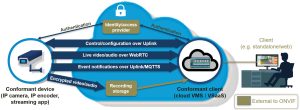
Profile V enables a cloud VMS to reach a device (e.g., camera) behind a local firewall—typically without port forwarding or complex VPN configurations. This is achieved by requiring the device to initiate the connection through a secure Uplink channel.
- Uplink initiation: The conformant device initiates an outbound connection to the cloud-based conformant client over WSS (WebSocket Secure).
- Authentication: The system uses the OAuth 2.0 framework (mutual TLS and access tokens) to establish a trusted, bidirectional communication channel. The device authenticates with the conformant client. After the Uplink connection is established, the conformant client can configure the device.
- Data transmission: The device can securely stream low-latency live video and, if applicable, audio over WebRTC; send event notifications; and push encrypted video and, if applicable, audio to cloud storage for recording.
- Remote access: With the conformant client or a modern standard web client that supports WebRTC and MQTTS protocol, users can remotely access live video and, if applicable, audio; speak through the device if audio output is supported; and get alerts so that actions can be taken. Recordings may be accessible from the conformant client or from a cloud storage provider.
Conformance requirements
For conformant devices (IP cameras, encoders, streaming apps)
An ONVIF Profile V conformant device must, among other things, be able to:
- Establish a secure Uplink connection to an ONVIF Profile V conformant client using WSS protocol
- Support authentication methods based on mutual TLS (mTLS) and access tokens
- Stream H.264-encoded video over WebRTC
- Encrypt and push video and audio (where supported) to cloud storage (like Amazon AWS S3 or Microsoft Azure Blob Storage) for recording
- Send pull-point event notifications over Uplink or JSON event notifications over MQTTS protocol
- Support bidirectional audio streaming over WebRTC (if audio hardware is present)
For conformant clients (Cloud VMS, VSaaS)
A cloud-hosted ONVIF Profile V conformant client must, among other things, be able to:
- Configure or manage an ONVIF Profile V conformant device remotely and securely
- Support the Uplink setup request using WSS protocol
- Support authentication methods based on mTLS and access tokens
- Initiate and receive H.264-encoded video streaming over WebRTC
- Configure the device to push video and audio (where supported) to cloud storage for recording
- Receive pull-point event notifications over Uplink or JSON event notifications over MQTTS protocol
- Support bidirectional audio streaming over WebRTC (if there is native support for audio)